About this site
Who deals with subsidence in Leeds?
Read how this site handles enquiries about subsidence in Leeds. Sending details costs nothing, carries no obligation, and helps you find out what the crack in your home means before you decide on any work.
A single point of contact for Leeds homeowners
Leeds Subsidence takes enquiries from people who have noticed cracks, sticking doors or sloping floors in their homes. The site exists so that one form reaches the right specialist firm without the homeowner needing to know which trade applies.
Subsidence problems cross several disciplines. A crack might need a structural survey, drain repair, tree management or foundation work. Knowing which one comes first is difficult when you are looking at your own wall and wondering if the house is safe.
This site holds information about each of those paths. It covers underpinning, resin injection, screw piling and concrete cracking across Leeds and its surrounding towns. The pages describe what each method involves and where it tends to apply, so you can read up before you send anything in.
Separate firms carry out the surveys and repairs
The companies that visit homes, dig trial holes, monitor cracks and pour concrete are independent businesses. They operate across Leeds, from stone semis in Horsforth to post-war estates in Middleton and terraced streets in Armley.
Each firm specialises in a particular part of the problem. Some focus on ground investigation and monitoring. Others handle the physical repair work, such as installing piles or injecting resin beneath a sinking slab. Because the trades differ, the right firm depends on what the ground and the building are doing.
When you send an enquiry through this site, the details go to a firm equipped for that specific situation. You do not need to guess whether your problem is a drainage fault, a tree root issue or something deeper. The initial description you provide determines which discipline picks it up.
What happens after you send details in
The form asks for your location, a description of the damage and how long you have noticed it. That information tells the receiving firm whether they cover your area and whether the symptoms match their trade.
They review the details and decide if a site visit makes sense. Sometimes the answer is that the crack is seasonal movement rather than progressive subsidence. Other times a survey is the only way to rule out a failing drain or shrinking clay.
Nothing commits you to hiring anyone by filling in the form. It starts a conversation with someone who understands Leeds geology, from the coal measures under Kippax to the alluvial ground near Kirkstall. If the problem turns out to be minor, you will hear that too. The aim is clarity about your home, not pressure to buy work you might not need.
Where your role ends and the specialist begins
You describe the damage and say where your home is. The specialist firm takes over from there, handling the technical assessment, the diagnosis and any repair work that follows.
What you do
- Describe the cracks, sticking doors or uneven floors you see
- Say where your home is and how long the problem has been visible
- Reply if the firm needs access to inspect the building
What a specialist does
- Review the description against local soil and mining records
- Visit the home to examine the damage and take measurements
- Carry out ground investigation or drain testing if needed
- Propose a repair method suited to the cause they find
- Complete the stabilisation or foundation work
How a specialist identifies the cause
The order matters because surface symptoms rarely reveal the full story. Checking the simplest explanation first prevents unnecessary excavation and keeps the focus on what the ground is actually doing beneath the house.
-
Visual inspection of cracks and walls
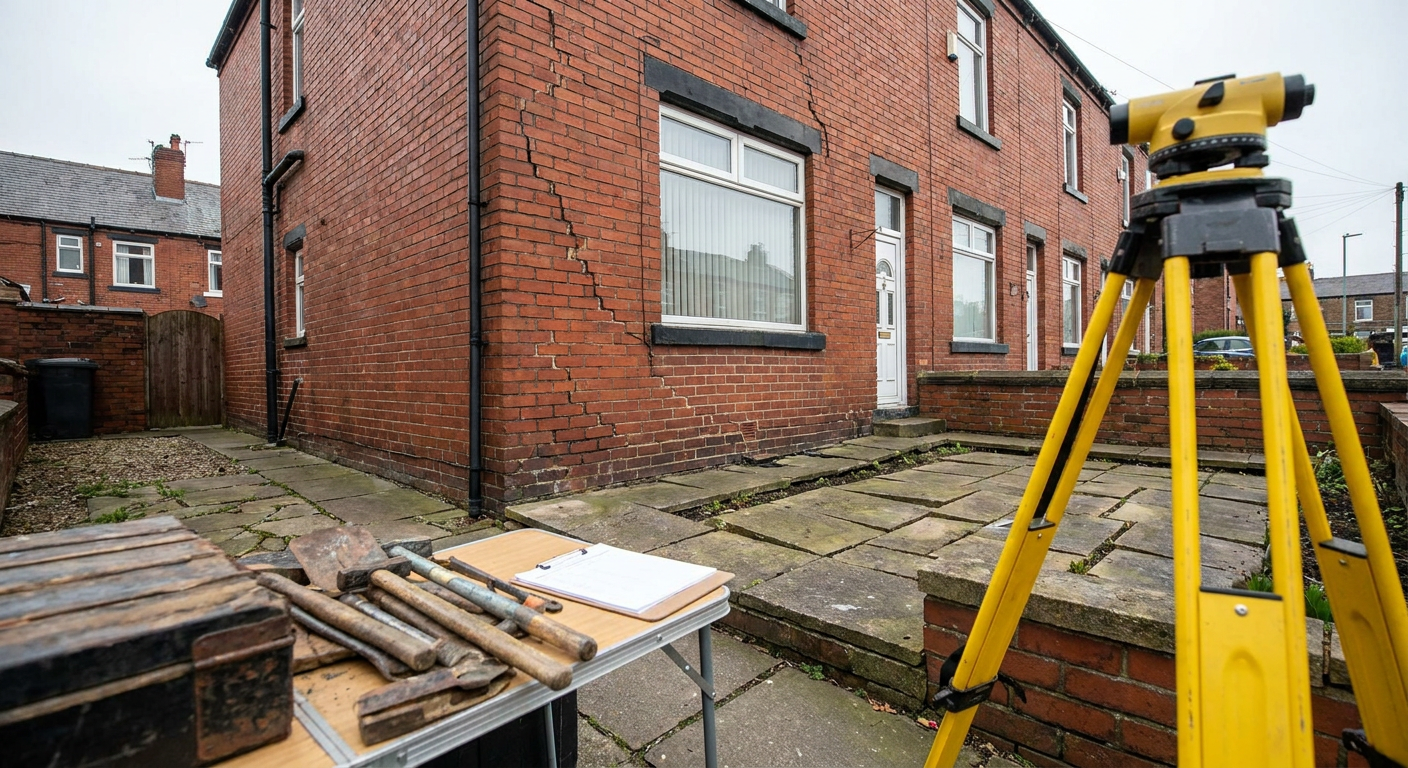
The specialist measures crack widths, traces their direction across the wall and records their exact position. This method separates seasonal thermal movement from ongoing foundation settlement or heave, ruling out harmless plaster shrinkage where the pattern shows no structural cause.
-
Drainage survey using CCTV cameras
A camera runs through underground pipes to find fractures or blockages where escaping water could be washing fine soil away from footings.
-
Trial holes dug beside the foundations
Small excavations expose the footing depth, soil type and moisture content to confirm whether the bearing stratum has shrunk or softened.
-
Level monitoring over several months
Precise measurements taken at fixed points track whether the building is still moving or has settled into a stable position.
If visual signs and ground data conflict, the specialist extends the monitoring period before recommending any permanent repair.
Send the details of what you have noticed
Your description goes to a firm that handles that type of ground or structural problem in Leeds. Sending it does not commit you to any work, a survey or a cost. It starts the process of finding out what the damage means for your home.
- No obligation to proceed
- No fee for sending details
- Handled by local firms